Seismology is a branch of geophysics that focuses on the study of seismic waves generated by earthquakes and other seismic events. These waves propagate through the Earth's interior, providing vital information about the planet's internal structure and the dynamic processes that occur beneath the surface. Seismology plays a crucial role in understanding not only the mechanisms of earthquakes but also the properties of the Earth's crust, mantle, and core. Through the analysis of seismic waves, seismologists can map the Earth's internal layers, identify regions of tectonic activity, and contribute to earthquake hazard assessments.
The cross-sectional diagram of the Earth reveals the propagation of two primary types of seismic waves: P-waves (Primary waves) and S-waves (Secondary waves). P-waves are compressional waves that move the fastest and can travel through both solid and liquid layers of the Earth. They compress and expand the material they move through, similar to how sound waves propagate through the air. S-waves, on the other hand, are shear waves that travel slower than P-waves and can only move through solid materials. They move the ground perpendicular to their direction of travel, causing more shaking and often more damage during an earthquake. The distinct behaviors of P-waves and S-waves as they pass through different layers of the Earth provide critical clues about the composition and state of these layers.
By studying the speed, direction, and interaction of seismic waves with the Earth's interior, seismologists gain valuable insights into the planet's internal structure. The way these waves are refracted, reflected, or absorbed as they pass through different layers helps scientists determine the composition, density, and physical state of the Earth's materials. For example, the fact that S-waves do not travel through the Earth's outer core indicates that this layer is liquid, while P-waves' ability to pass through all layers provides a more comprehensive picture of the Earth's inner structure. These insights are essential not only for understanding the Earth's geology but also for assessing seismic risks and improving earthquake preparedness and mitigation strategies.
Basics
What is an Earthquake
Understanding Earthquakes and Their Occurrence
An earthquake is a sudden release of energy in the Earth's crust that creates seismic waves, often resulting in ground shaking and, in severe cases, significant destruction. This energy release is usually caused by the movement of tectonic plates, which are large slabs of Earth's lithosphere. As these plates move, they can become stuck due to friction. When the stress on the rocks exceeds their strength, they break and slip along faults, releasing energy that radiates outward as seismic waves. The point on the Earth's surface directly above where the earthquake originates is called the epicenter, while the point within the Earth where the energy release actually occurs is known as the focus or hypocenter.
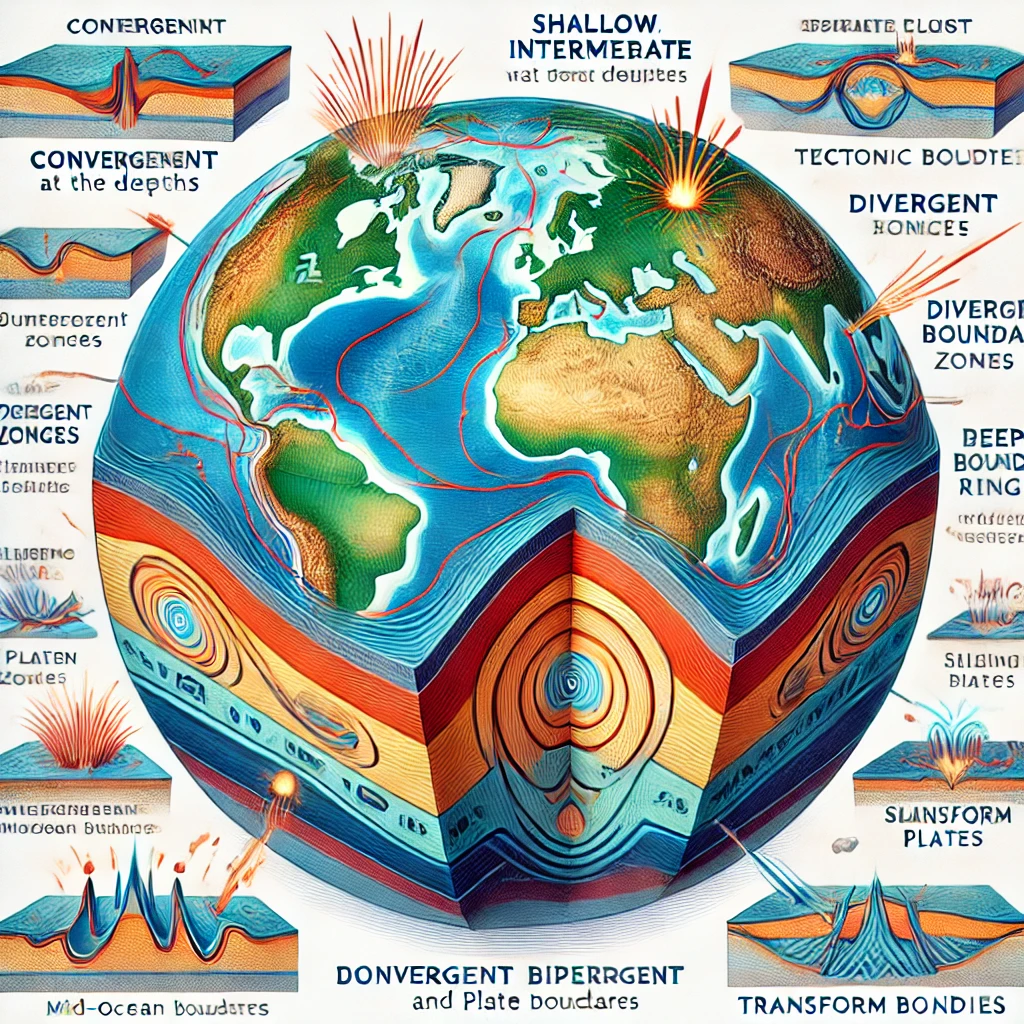
Earthquakes can occur at various depths beneath the Earth's surface, classified into three types based on their focus depth: shallow, intermediate, and deep focus earthquakes. Shallow-focus earthquakes, occurring at depths less than 70 kilometers, are the most common and often the most destructive due to their proximity to the surface. Intermediate-focus earthquakes occur at depths between 70 and 300 kilometers, while deep-focus earthquakes, occurring at depths greater than 300 kilometers, are typically found in subduction zones where one tectonic plate is forced deep beneath another. These deeper earthquakes are less likely to cause severe damage on the surface but can provide important information about the Earth's interior.
The occurrence of earthquakes is closely linked to the boundaries between tectonic plates, which are classified into three main types: convergent, divergent, and transform. At convergent boundaries, plates move towards each other, and one plate may be forced beneath another in a process known as subduction. This often results in powerful earthquakes, particularly in subduction zones, which can generate tsunamis if they occur underwater. Divergent boundaries, where plates move apart, are typically found along mid-ocean ridges and are associated with less intense, though frequent, earthquakes as new crust is formed. Transform boundaries occur where plates slide past each other horizontally, leading to earthquakes along faults like the San Andreas Fault in California.
Understanding the relationship between earthquake occurrence and plate tectonics is crucial for assessing seismic risks and preparing for potential natural disasters. The study of earthquake patterns, depths, and plate boundaries helps seismologists predict where future earthquakes are likely to occur and how they might impact affected regions. By examining the types and characteristics of earthquakes in different tectonic settings, scientists can better understand the dynamic processes shaping our planet's surface and develop strategies to mitigate the impacts of these powerful natural events.
References:
w

Earthquake Source Parameters
Hypo-center Location
Origin time
Magnitude
Focal mechanism
Rupture characteristics
Earthquake Source Parameters: Understanding the Key Elements
When studying earthquakes, seismologists focus on several key source parameters that provide critical information about the nature and impact of an earthquake. These parameters include the hypocenter location, origin time, magnitude, focal mechanism, and rupture characteristics. Each of these elements helps scientists to understand the dynamics of the earthquake, its potential impact, and the processes occurring within the Earth that led to the seismic event.
The hypocenter location, also known as the focus, is the point within the Earth where the earthquake begins. This is the actual location where the strain energy stored in rocks is first released, initiating seismic waves that radiate outward. The depth of the hypocenter is particularly important, as it influences the type and intensity of ground shaking experienced at the surface. The epicenter, which is the point on the Earth’s surface directly above the hypocenter, is often used to describe the location of an earthquake in geographic terms. However, the depth and precise location of the hypocenter provide more detailed insights into the nature of the earthquake and its potential to cause damage.
The origin time of an earthquake refers to the exact moment when the rupture occurs at the hypocenter, marking the start of seismic wave generation. Accurate determination of the origin time is essential for understanding the timing of seismic events and for coordinating global seismic monitoring efforts. By knowing the origin time, seismologists can trace the propagation of seismic waves to various locations, helping to pinpoint the earthquake’s location and magnitude. This information is crucial for early warning systems, which rely on rapid detection and communication of earthquake data to mitigate the impact on affected populations.
Magnitude is a measure of the size or energy released by an earthquake, typically quantified using the Richter scale, moment magnitude scale, or other related scales. The magnitude is determined by the amplitude of seismic waves recorded by seismographs and provides a standardized way to compare the energy of different earthquakes. Larger magnitude earthquakes release more energy and have the potential to cause widespread destruction, especially in densely populated areas. The magnitude scale is logarithmic, meaning that each whole number increase represents a tenfold increase in measured amplitude and approximately 32 times more energy release.
The focal mechanism of an earthquake describes the orientation of the fault plane and the direction of slip during the rupture. This information is often represented by a "beachball" diagram, which shows the pattern of seismic wave radiation from the earthquake source. The focal mechanism helps seismologists understand the type of faulting that occurred—whether it was normal, reverse, or strike-slip—and the stress orientation in the Earth's crust that led to the earthquake. Understanding the focal mechanism is important for assessing the tectonic setting of the earthquake and predicting the types of aftershocks that might follow.
Rupture characteristics include the details of how the earthquake rupture propagates along the fault. This encompasses the length and width of the rupture, the speed at which it propagates, and the amount of slip that occurs along the fault. The rupture process is complex and can vary significantly between different earthquakes. For instance, a rupture that propagates quickly along a long fault segment can result in a more intense earthquake with greater ground shaking. The study of rupture characteristics helps seismologists to model the earthquake's impact on the surface, including the distribution of shaking intensity and the potential for secondary hazards such as tsunamis or landslides.
Together, these earthquake source parameters provide a comprehensive understanding of an earthquake's characteristics, from its initiation deep within the Earth to its effects on the surface. This knowledge is crucial for improving earthquake preparedness, enhancing building codes, and reducing the risks associated with seismic activity.
References:
w